

China Quality Control Checklist: 15 Essential Checks Before Importing Products
China is still the first place many buyers look when they need products made. Manufacturing made up 27% of the country’s GDP, and thousands of businesses, including major Western brands, source goods there. The savings are real. So are the risks. You often can’t see the goods until they arrive, and a hidden problem can cost far more than the money you saved on price. Quality trouble rarely comes from one big mistake. It builds from small gaps: a vague spec, a skipped check, a carton nobody counted. A checklist closes those gaps. The 15 checks below follow the life of an order, from first contact to the loaded container. Why Do Importers Need a Quality Control Checklist? “Made in China” carries a poor-quality reputation in some circles. That belief is far from true for many factories. Experienced manufacturers invest in skills, equipment, and good raw materials, and they accept third-party inspection when buyers ask for it. What they need from you is clarity. A checklist tells the factory which standards apply and when they will be checked. It also gives you a record if a dispute comes up later. Stage 1: Before You Place the Order 1. Write Down Your Quality Requirements Spell out your specifications, the inspections you expect, and the safety standards that apply. Be precise. Ask an experienced translator to put the requirements into Chinese, then confirm the factory understood them. 2. Look Past the Golden Sample Many buyers approve one sample and tell the factory to start. That is risky. A single approved sample is not enough without written specifications behind it. 3. Match Your Price to Your Quality Goals Good raw materials, equipment, and skilled workers cost money. If the price is set too low, the factory may be forced to use cheaper materials and less experienced labor. Realistic standards and realistic prices go together. 4. Vet the Manufacturer For made-to-order products, a factory that specializes in your niche usually beats a large general plant. Before you commit, confirm the factory can do the following: 5. Audit the Factory A factory audit tests a supplier’s on-site quality control system. The auditor looks at six areas: The factory then receives a rating based on ISO 9001 quality management standards. This report only conducts on-site assessments with reference to this standard and does not constitute an official ISO certificate. An audit also helps you confirm the supplier is legal and follows its contract. Stage 2: At the Start of Production 6. Inspect the Raw Materials An initial production check looks at the availability and condition of raw materials. It covers the period from before production begins until about 20% of the order is complete. It usually starts several weeks before your shipment is due. 7. Confirm Production Is Ready Review the production schedule and the factory’s in-house quality control process. Fixing a problem now saves rework later. Stage 3: While Production Runs 8. Inspect During Production A during production inspection happens when roughly 10% to 60% of the goods are made. Its purpose is to find the root cause of defects while they are still happening, so they don’t reach the finished product. 9. Check Workmanship, Style and Color Compare finished and semi-finished units against your approved specifications. Look at how they are made and whether styles and colors match. 10. Pick Real Production Samples Factories often have very skilled sample makers. The sample on your desk may not match what comes off the line. Have an inspector pick random samples from the factory floor, seal them, and send them to you. Stage 4: Before the Goods Ship A pre-shipment inspection takes place when the order is at least 80% complete and packed. It is the last quality check before delivery, which is why it is also called a Final Random Inspection. 11. Count the Quantity Verify how many units are finished and packed. Do this before the containers move. 12. Check Artwork and Labels Look at printed artwork, labels, and markings. Mistakes here can be costly in your target market. 13. Measure Dimensions and Weight Compare size and weight to your specifications. 14. Test Function, Performance, Durability and Safety Product tests should match your requirements and the standards of the market you are selling into. 15. Inspect Packing, Packaging and Shipping Marks Check that cartons are strong enough for export and that shipping marks are correct. How Does AQL Sampling Work? You can’t open every carton, so inspectors check a sample. The method follows the ANSI/ASQC Z1.4 (ISO 2859-1) standard and uses an AQL table. Here is an example. Say you are producing 12,000 items. At general inspection level II, the standard level most buyers pick, the table gives the letter M, which means inspecting 315 items. Level I is less strict, and level III is the strictest. You then choose limits for critical, major and minor defects. Most importers use 0/2.5/4. With that setting and 315 samples, you should reject the shipment if the inspector finds: Buyers with high-risk products can choose tighter limits, such as 1/1/1 or 0/1.5/2.5. What Happens After the Inspection? Inspections that cover every unit are also possible. That is called a full inspection, and it checks each product and removes the defective ones. Once the goods pass, container loading supervision comes next. Inspectors verify the quantity loaded, confirm the packaging, labeling and shipping marks, examine the export cartons and containers, supervise the loading and review the shipping documents. This helps prevent fraud and trade disputes. A few practical points for your schedule: Tying payment to inspection results is another smart move. If the inspection finds problems, the factory must remake the goods to be paid. Summary A strong quality plan starts before the order and continues until the container is sealed. Write your requirements down, pick the right factory and audit it. Check raw materials early, inspect during production and run a final inspection when the order is at least 80% packed. Use AQL sampling so your results
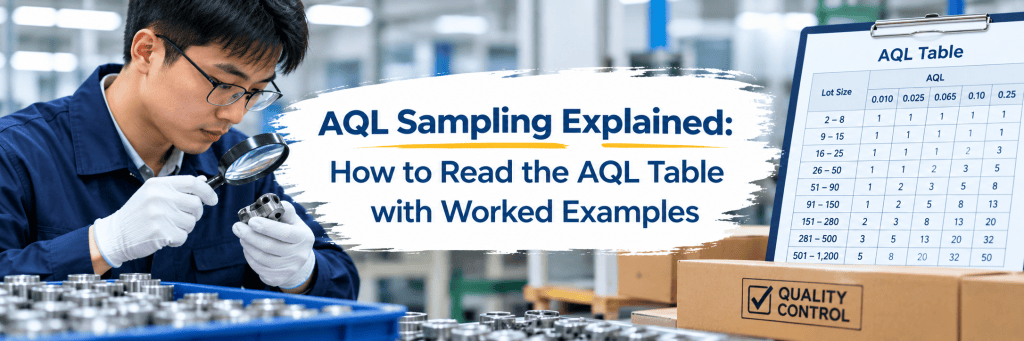
AQL Sampling Explained: How to Read the AQL Table with Worked Examples
When you order thousands of units from a factory, you cannot open every carton and test every piece. Sampling fills that gap. A small group of products is pulled at random and checked against your requirements. The findings then support one decision: accept the lot or reject it. That is the idea behind AQL, short for Acceptance Quality Limit. The method relies on a standard table, and the table can look confusing the first time you see it. This guide walks through it one step at a time, with a worked example you can follow on a calculator. What AQL Sampling Tells You (and What It Does Not) AQL sampling supports a decision about a production lot. It does not give you the exact defect rate of the whole shipment, and it will not point out every faulty unit among the pieces that were never opened. If you need each unit sorted, a full inspection is the better fit. An AQL number on its own does not define an inspection. Before you book, agree on these points with your inspection provider: How to Read the AQL Table Two charts do the work here. The first gives you a sample size letter. The second turns that letter into a sample size and sets your defect limits. Step 1: Find Your Lot Size Table I lists ranges for the total number of items produced. Find the range that matches your order quantity. That is your lot size. Step 2: Choose an Inspection Level Most clients use the general inspection levels. There are three: Your lot size and your chosen level meet at a letter in Table I. Keep that letter. You need it for the next step. Step 3: Read the Sample Size Go to the second AQL chart and find your letter. It points to the number of items the inspector will check. A bigger lot or a stricter level means more items in the sample. Step 4: Set Your Defect Limits The second chart shows defect levels from 0 to 6.5. You can pick a level for each type of defect: Most importers choose 0/2.5/4. In plain terms, that means no critical defects are accepted, major defects are held to the 2.5 level, and minor defects to the 4 level. For high-risk products, such as those found in the automotive industry, you can choose 1/1/1 or 0/1.5/2.5 instead. Worked Example: 12,000 Units at Level II Say your factory produces 12,000 items. You choose inspection level II and the standard 0/2.5/4 defect limits. Here is how the table plays out: You reject the shipment if the sample shows more than 0 critical defects, more than 14 major defects, or more than 21 minor defects. Put another way, a single critical defect fails the lot. So do 15 major defects. So do 22 minor defects. Three Sample Results Now see how the same plan handles different findings from those 315 items. Result C surprises some buyers. The low numbers elsewhere do not rescue the lot, because each defect type is judged against its own limit. What to Do When Results Land Close to the Limit Suppose the inspector finds exactly 14 major defects. That is still inside the limit, but only just. When findings come near the AQL limits, recheck whether that level of defects is acceptable for your product and your customers. What you do after the report is your decision. Most importers go through the findings with their vendor or manufacturer so problems can be corrected wherever possible. How AQL Fits Into Pre-Shipment Inspection At Jonble, a pre-shipment inspection starts with random sampling of your goods under the ANSI/ASQC Z1.4 (ISO 2859-1) standard. The selected samples then go through product tests and an AQL inspection. The visit takes place at the factory or the forwarder’s warehouse, once the order is at least 80% complete and packed. The checklist is tailored to your requirements and the quality standard of your target market. It can include: You receive a detailed report by email within 24 hours of the inspection. The team also helps you interpret the results and sort out supplier issues, which is useful when your numbers sit close to the limits. Summary AQL sampling gives you a clear rule for accepting or rejecting a lot. It is a decision tool, not an exact defect count for the shipment. Planning an inspection for your next order? Send Jonble your order quantity, preferred inspection level, defect limits, and shipment date, and the team will build an AQL plan around your product.